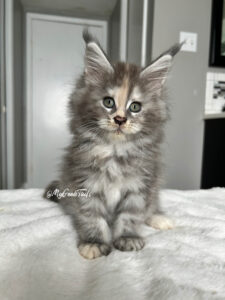
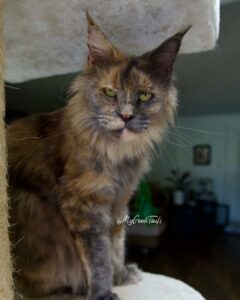
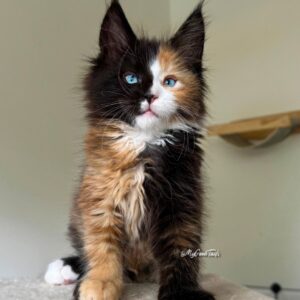
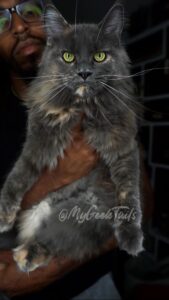
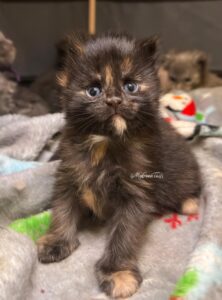
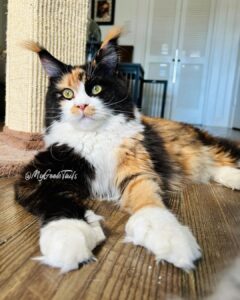
The beauty of tortie genetics is one of the most fascinating aspects of breeding Maine Coon kittens. Tortoiseshell, often called tortie, patterns are not just visually striking but genetically complex. For many Maine Coon enthusiasts, tortie kittens represent a perfect blend of science and art, where no two cats are ever exactly alike. At MyGeekTails, we love educating future owners on what makes tortie Maine Coon kittens so unique, especially when combined with agouti genetics and rare color pairings.
The introduction of the Tortie
Tortie coloring is created by the interaction of two main pigments: black-based colors and red-based colors. These pigments appear in random patches across the coat, resulting in endless variations. What makes tortie Maine Coon kittens even more special is that the tortie pattern is linked to the X chromosome. There has been only handful of rare cases where we have found male Maine Coons as torties. This is why nearly all tortie cats are female, making them even more sought after among Maine Coon lovers.
In tortie Maine Coon kittens, each X chromosome carries a different color instruction. One X chromosome may carry the gene for black-based coloring, while the other carries the gene for red-based coloring. During early development, one X chromosome in each cell is randomly turned off in a process called X inactivation. This creates distinct patches of color throughout the coat. Some cells express the black-based gene, while others express the red-based gene, resulting in the classic tortoiseshell pattern.
Understanding X and Y Chromosome
This random X inactivation is why no two tortie Maine Coon kittens ever look the same. The placement, size, and intensity of color patches are entirely unpredictable, making each kitten genetically and visually unique. At mygeektails.com, we often explain to families that tortie coloring is not something that can be precisely controlled, which adds to its beauty and rarity.
Male tortie Maine Coons are extremely rare because males typically have only one X chromosome. Since a single X chromosome can only carry one color gene, males usually express either black-based or red-based coloring, but not both. In rare cases, a male Maine Coon kitten may be born with an extra X chromosome (XXY). These rare males can display tortie coloring, but they are uncommon and often sterile.
The agouti gene adds another layer of complexity to tortie genetics. Agouti Maine Coon kittens show tabby striping within each color patch. When a tortie kitten carries the agouti gene, the black areas become brown or blue tabby, and the red areas become red tabby. This results in what is commonly called a patched tabby or torbie Maine Coon. These agouti tortie Maine Coon kittens often have incredibly detailed and textured coats.
Additional genes such as dilution and silver further influence how tortie patterns appear. Dilution genes can turn black into blue and red into cream, creating softer pastel-colored tortie Maine Coon kittens. The silver gene lightens the base of each hair shaft, producing high-contrast silver tortie Maine Coons that are highly sought after by Maine Coon enthusiasts.
White spotting genes can also affect tortie coloring. Tortie and white Maine Coon kittens may have large areas of white combined with their tortie pattern. When white coverage is extensive, these kittens may be referred to as calico, although genetically they are still torties.
At mygeektails.com, we focus on ethically breeding Maine Coon kittens with excellent health, temperament, and genetic diversity. Our tortie Maine Coon kittens are raised in a loving environment, allowing their colors and personalities to fully develop over time. Understanding X and Y chromosome genetics helps families appreciate why tortie Maine Coons are almost always female and why their patterns are so beautifully unpredictable.
The beauty of tortie genetics lies in its complexity. From X chromosome expression to agouti patterning and dilution effects, tortie Maine Coon kittens represent one of the most intricate coat types in the feline world. When you welcome a tortie Maine Coon from MyGeekTails, you are bringing home a truly unique piece of genetic art.
When we dive deeper into tortie genetics, coat color becomes more than just black and red. Dilution genes can soften these colors into blue and cream, producing blue tortie Maine Coon kittens. Other genetic modifiers can influence the warmth, contrast, and distribution of color patches. This is why tortie kittens from the same litter can look dramatically different from one another, even though they share the same parents.
One of the most exciting combinations in tortie Maine Coons is the presence of the agouti gene. Agouti Maine Coon kittens display tabby striping within each color patch. Instead of solid blocks of color, agouti torties show intricate patterns where black becomes brown tabby and red becomes red tabby. This creates an extraordinary level of depth and detail in the coat, often described as marbled, patched, or mosaic-like.
What is an Agouti Tortie?
Agouti tortie Maine Coon kittens can appear in many forms, including brown patched tabby, blue patched tabby, and even silver tortie variations. The silver gene adds a light base to each hair shaft, making colors appear brighter and more contrasted. This results in stunning silver tortie Maine Coons with high visual impact and dramatic coat definition.
Another factor that influences tortie coloring is white spotting. Tortie and white Maine Coon kittens may have large areas of white mixed with their tortie pattern, creating what is often called calico when the white coverage is extensive. These kittens still carry the same tortie genetics but present them in a lighter, more balanced appearance that many families find irresistible.
At MyGeekTails, we focus on ethically breeding Maine Coon kittens with strong health, temperament, and breed-standard features, while also celebrating the beauty of complex coat genetics. Our tortie Maine Coon kittens are raised with care and intention, allowing their colors to develop naturally over time. Many tortie kittens continue to change as they mature, with colors deepening, spreading, or becoming more defined during the first few years of life.
Understanding tortie genetics helps future owners appreciate that these kittens are truly one of a kind. No pattern can be replicated, and no formula guarantees an identical outcome. This unpredictability is part of what makes tortie Maine Coon kittens so special. When combined with agouti genetics, dilution, silver, or white spotting, the result is a living work of art.
The beauty of tortie genetics lies in its individuality. Whether you are drawn to bold contrasts, soft pastel tones, or intricate agouti patterns, tortie Maine Coon kittens offer endless variety and charm. At MyGeekTails, we are proud to share this genetic artistry with families looking for a truly unique Maine Coon companion.